Biography
Early life in Folkestone and Boulogne 1880–1900
Section titled “Early life in Folkestone and Boulogne 1880–1900”Susan Spain-Dunk was born in Folkestone, England, in 1880, into a family of amateur musicians. Susan’s mother and elder sister Ethel both played the piano. Susan’s father, William Dunk, was a builder and master plumber who owned a building company in Folkestone. Susan’s second name, Spain, was added because of a connection between the Dunk family and the local Spain family.
Susan taught herself to play the violin and had her first formal music lessons from the age of 12. As a child she would go on holiday with her brothers and sister to a farm near Paddlesworth which instilled in her a great love of the Kent countryside. In adult life she would take numerous walks in Kent to relieve the stress of life in London and to gain inspiration for her music.
Susan attended St Michael’s Church in Folkestone, an Anglican church. The vicar, Rev. Edward Husband, was a talented musician who had his own church orchestra where Susan and her brother John played the violin. As a teenager she performed as a soloist with the orchestra.
In 1894 Susan’s parents transferred her to a boarding school in Boulogne-sur-Mer for two years, where she enjoyed acquiring an appreciation of French culture. She continued her musical education and began to compose music, her first piece being Melody in 1894. Her music teacher was Vincent Henneker who was based in Ramsgate; she was the soloist with his orchestra performing Mendelssohn’s Violin Concerto in 1900. Susan passed her higher grade music exams with honours and her parents somewhat reluctantly agreed to Vincent Henneker’s proposal that she should study in London for a musical career.
Student life in London at RAM and the Guildhall School of Music 1901–1905
Section titled “Student life in London at RAM and the Guildhall School of Music 1901–1905”In 1901, Susan became a student at the Guildhall School of Music in London. In 1902, Susan’s violin professor Alfred Gibson arranged for her to transfer to the Royal Academy of Music (RAM) on the Licentiate (LRAM) course. While continuing her violin and viola lessons with Alfred Gibson, she also took harmony under Ebenezer Prout and composition under Stewart Macpherson. Her fellow students at RAM included the brilliant young composer and pianist York Bowen, with whom she composed a song, Is It A Sin To Love Thee As I Do? (words by Susan Spain-Dunk, music by York Bowen) as well as the soprano Ida Kahn.
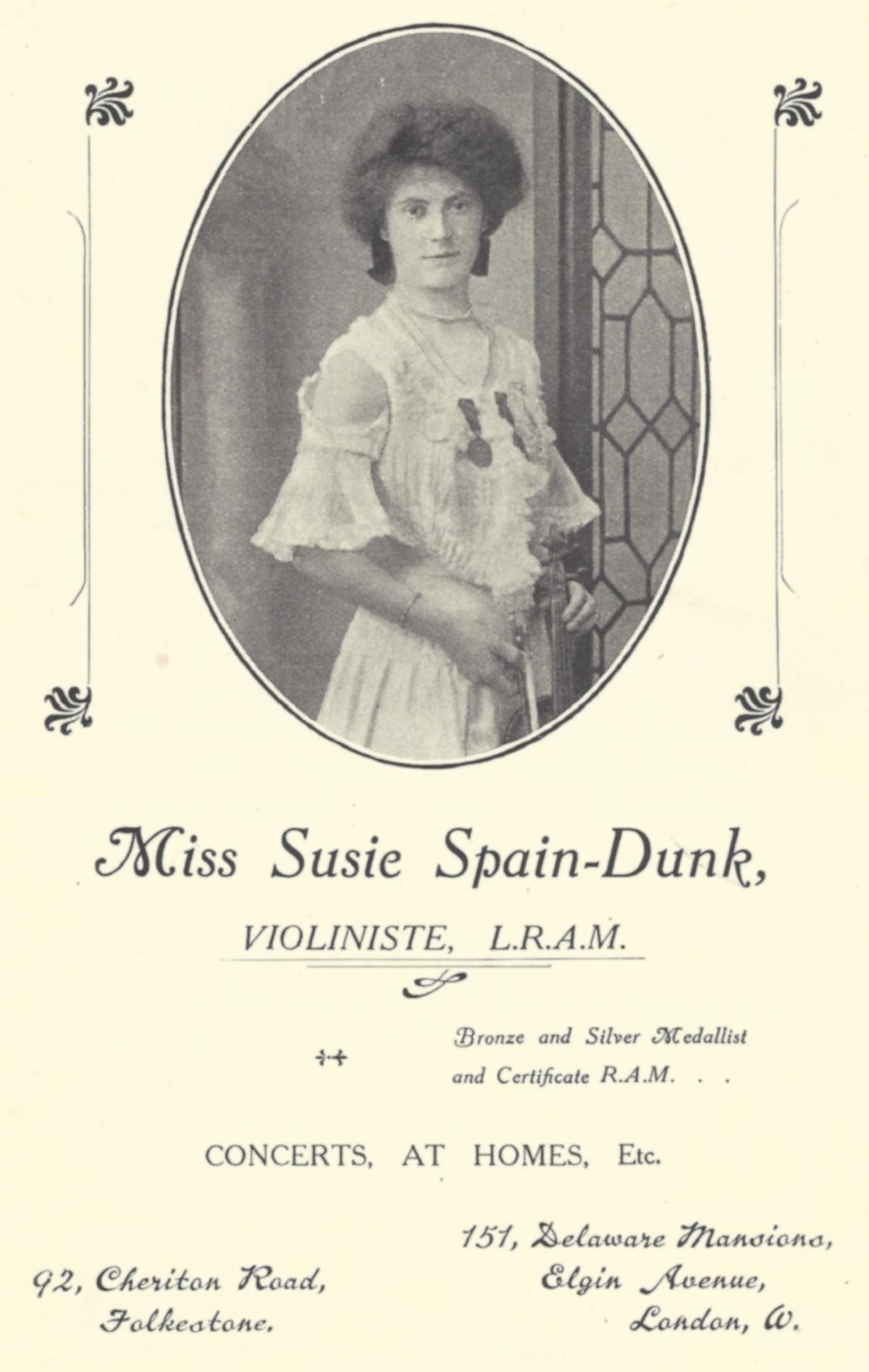
In 1903, Susan was awarded two RAM bronze medals, for violin playing and sight-singing. By this time she had adopted the surname ‘Spain-Dunk’. In the following year she won two silver medals in the same subjects. In 1905 Susan gained her LRAM qualification and continued to study at RAM taking advanced courses in composition and orchestration.
Early musical career and marriage 1906–1920
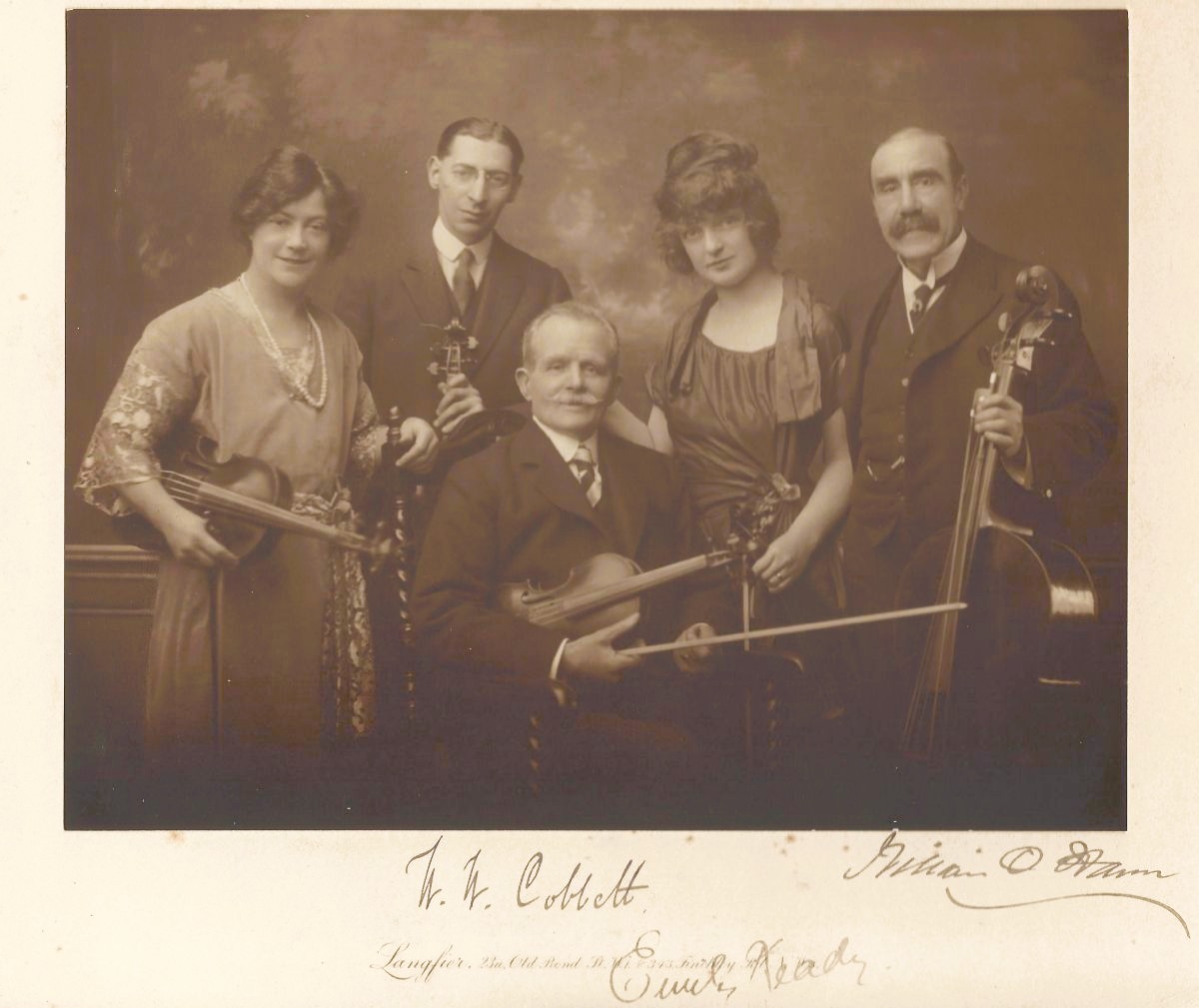
Section titled “Early musical career and marriage 1906–1920”Susan won RAM’s Charles Mortimer Prize for Composition in 1906 with two pieces for viola and piano. She was also elected as an Associate of RAM. That year she submitted her first orchestral work Geraint and Enid, a tone poem, to a competition for women composers organised by The Gentlewoman newspaper. It was specially commended and performed at an Academy concert. In 1907 Susan was awarded a Consolation Prize in W. W. Cobbett’s competition for her Phantasy in A Minor. Her Petite Serenade for Flute and Piano, her first published work, was published in this year and dedicated to Nora Crump the flute teacher.
Susan had met Henry Gibson, a nephew of Alfred Gibson and a musician and composer, at the Guildhall School of Music. In 1903 they wrote Thelma, a short piano piece, together. They became engaged in 1904 and were married at Christ Church, Folkestone, in January 1908. Susan and Henry began their married life in West Kensington, London, performing and composing professionally. Susan published her Two Scandinavian Dances for Violin and Piano. They were performed at the Bechstein Hall on 28 May 1908 by Hilda Barnes, the violinist, to whom she dedicated the works. The Morning Post reported:
A novelty was provided in the form of Two Scandinavian Dances – Halligan and Springdas the compositions of Miss Susan Spain-Dunk who personally played the pianoforte accompaniments. Both pieces indicate genuine musical perceptiveness.
— Morning Post, 28 May 1908
Several more of Susan’s early pieces were soon accepted by publishers: Two Pieces for Flute and Valse Caprice. In 1909 Susan won a Supplementary Prize in the Cobbett competition for her Violin Sonata in B minor, the Romance from which was published. When she performed the piece, and another composition, Les Sylphes, at a concert with her husband in 1910 the programme indicated the violin soloist as ‘Mrs Henry Gibson’ and the composer as ‘S. Spain-Dunk’. In the 1911 census Henry’s profession is indicated as ‘Professor of Music’ and Susan’s as ‘Housewife’. Although Henry was also an accomplished musician, by this time Susan appears to have achieved greater recognition as a composer.
In November 1911 Susan and Henry’s son Alan was born.
During the First World War Henry Gibson served in the British Army in the Royal Artillery on the Western Front. Susan remained in London with her son and taught music at the Colet Court Preparatory School. In 1915 she composed her Phantasy Quartet in D minor for two violins, viola and cello and her Second Phantasy for two violins and piano. Between 1915 and 1920 she wrote two sonatas for violin and piano, two string quartets and two phantasies for strings. When the First World War ended Henry helped to organise the New Symphony Orchestra in which he played violin, and he later played for the British National Opera company.
Conducting at the Promenade Concerts 1924–1927
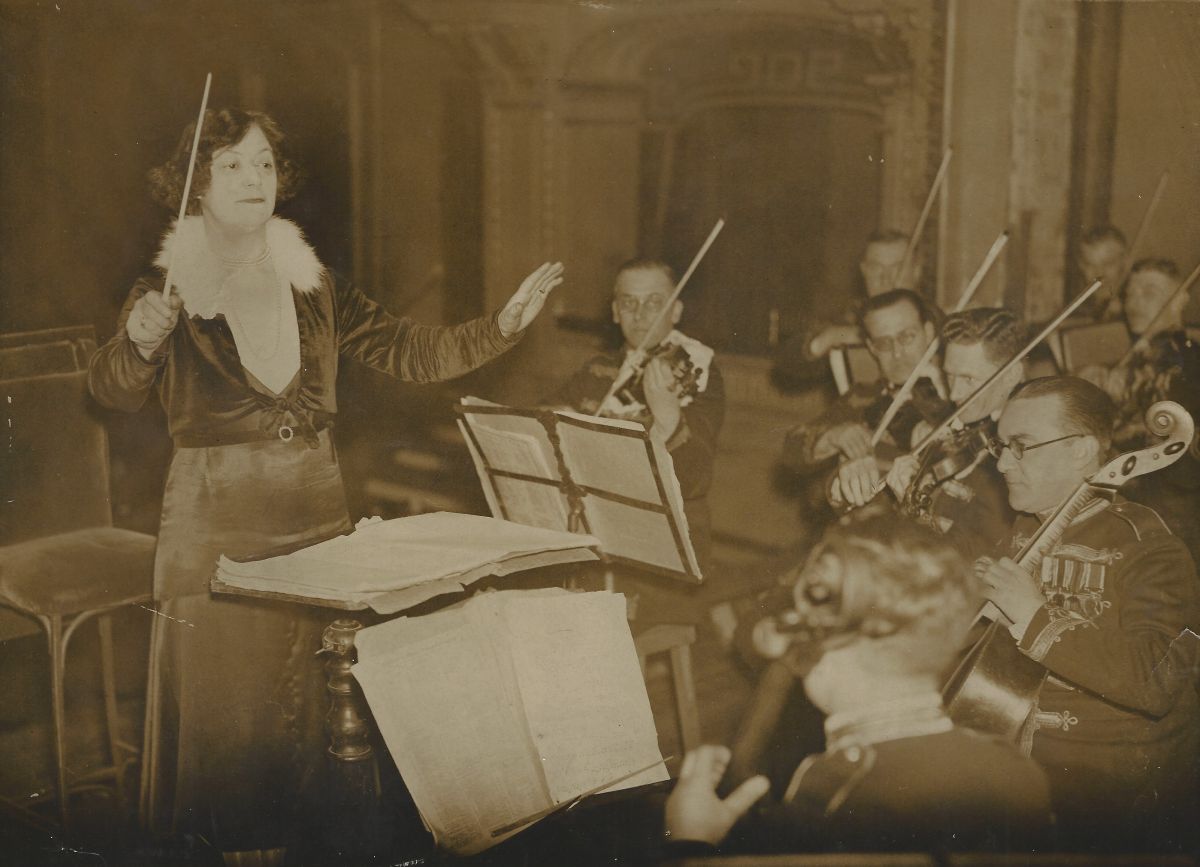
Section titled “Conducting at the Promenade Concerts 1924–1927”In 1923 Susan composed her Suite for String Orchestra and sent it to Sir Henry Wood to see if he would include it in his Promenade Concert programme. He replied that he would, and that if Susan would take his course on conducting at RAM she could conduct it herself. At that time nearly all pieces at the Promenade Concerts were conducted by Sir Henry Wood. An exception was made for new works by composers who were also conductors; they would be invited to conduct their own works. The Promenade Concerts (known as the ‘Proms’) were held at the Queen’s Hall in London until it was destroyed by bombing in 1941 when they were continued at the Albert Hall. On 21 August 1924 Susan became the second woman to conduct at a Promenade concert, the first having been Dame Ethel Smyth who conducted at her first Prom in 1913. Susan’s appearance was a success and the Morning Post reported on 23 August 1924: ‘Miss Spain-Dunk brought worthy matter with her, for her Suite is good music with the additional quality of being scholarly’. The Daily Express wrote:
For the second time only in a century, the conductor’s stand at Queen’s Hall was occupied last night by a woman, Miss Susan Spain-Dunk, a noted musician. At the end Miss Spain-Dunk received an ovation, being recalled three times.
— Daily Express, 22 August 1924
Susan Spain-Dunk was the second woman to conduct a Promenade Concert (after Dame Ethel Smyth), but it should be noted that Florence A. Marshall had also conducted at the Queen’s Hall, conducting the South Hampstead Orchestra there earlier in the century.
The London Calling column of the Daily News wrote:
Fashion for Women Conductors. When Miss Susan Spain-Dunk conducted her Suite for Strings at the Promenade Concert on Thursday night she wore a long frock of creamy white – I think that was the colour – trimmed with white fur. It made an attractive picture – prettier that Sir Henry Wood’s black coated figure – but it was just a trifle distracting. So was the conductor’s fluent waves of the baton – Wagner’s baton it was – and the first movement was half through before one became reconciled to the unfamiliarity of it, and could pay undivided attention to the music. Anyway, Miss Spain-Dunk proved herself to be a competent musician and won the warm applause of the audience. More than that, I noticed the string players themselves gave her an exceptionally cordial greeting in that discreet way the strings have for applauding.
— Daily News, 23 August 1924
Susan conducted the piece using a broken baton that had been used by Wagner to conduct at the Royal Albert Hall in 1877.
In 1925 Susan composed her Idyll for Strings and The Water Lily Pool for Flute and Strings. She premiered them at the Queen’s Hall on 22nd May when she conducted the British Women’s Symphony Orchestra. The main conductor for this concert was Malcolm Sargent, newly appointed as the resident conductor for the Orchestra. Susan conducted these two works again at the Proms on 13 October and they were well received. The Observer commented that ‘her writing for strings is always effective’ and described The Water Lily Pool as ‘a lyrically imagined little piece for flute and strings in which the effective part for the solo instrument was very ably played’.
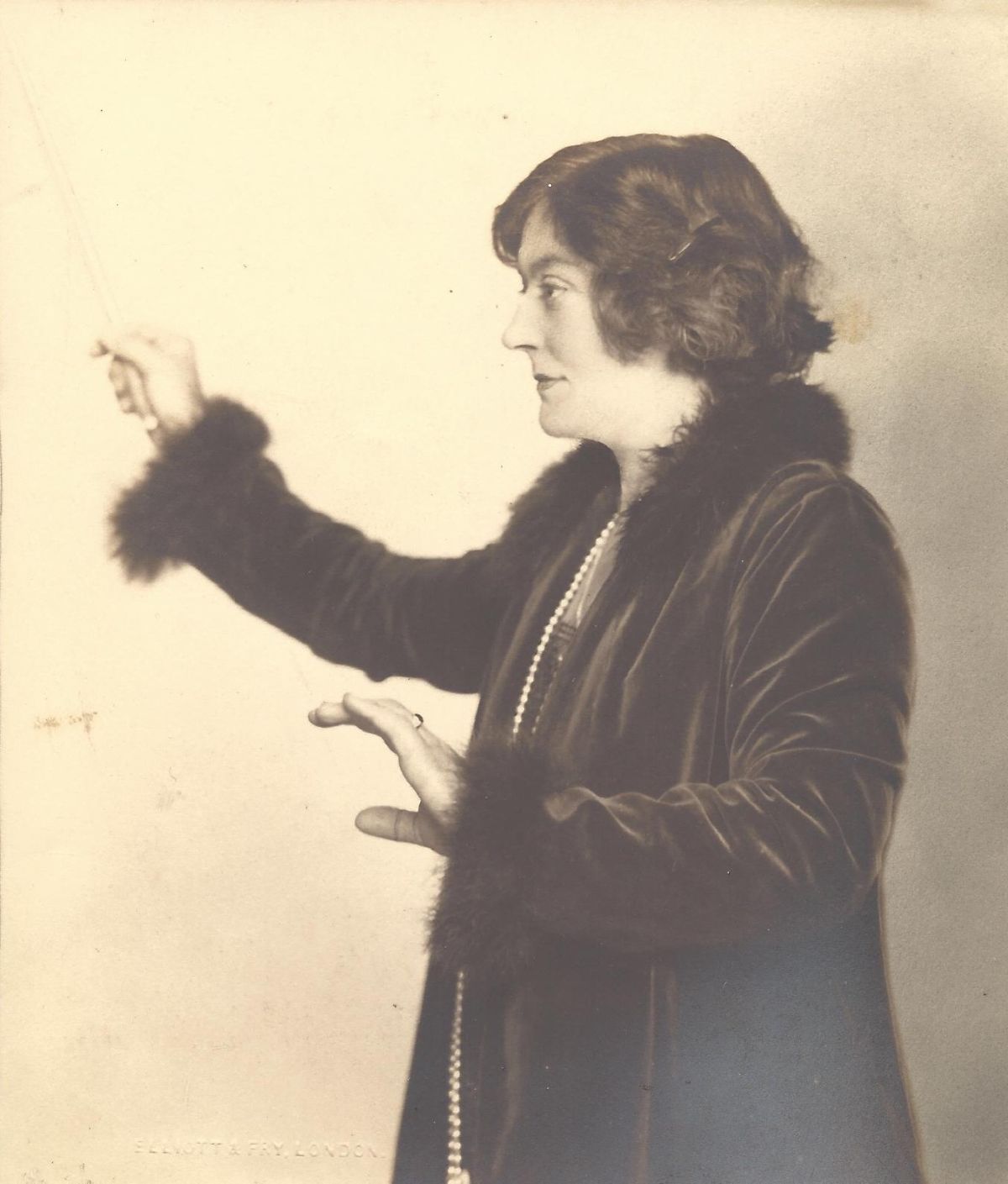
In 1926 Susan composed her lively The Kentish Downs overture, one of several pieces inspired by her many walks in the Kent countryside since childhood. She dedicated it to Dame Ethel Smyth and conducted it at the Proms on 30 August 1926. The Woman’s Leader journal wrote: ‘The Kentish Downs was conducted by a woman, Susan Spain-Dunk. The promenade audience, which is always discriminating, gave the work of the woman composer a very cordial reception’. The Daily Telegraph called it ‘a refreshingly forthright work’. The Daily Mirror wrote in its gossip column:
Miss Spain-Dunk has become a personage to the Queen’s Hall audiences nowadays. She has had something fresh included in the Proms programmes for three years running and conducts her work herself, but no one knows much about her personality, for she is shy of publicity in any shape or form, regarding herself so she says, as still a student. Slight, dark and self-possessed she is above all else a worker.
— Daily Mirror, 1 September 1926
Susan separated from Henry in 1926. This may partly explain her reluctance to discuss her private life publicly.
In February 1927 Susan was elected as a Fellow of the Royal Academy of Music (FRAM).
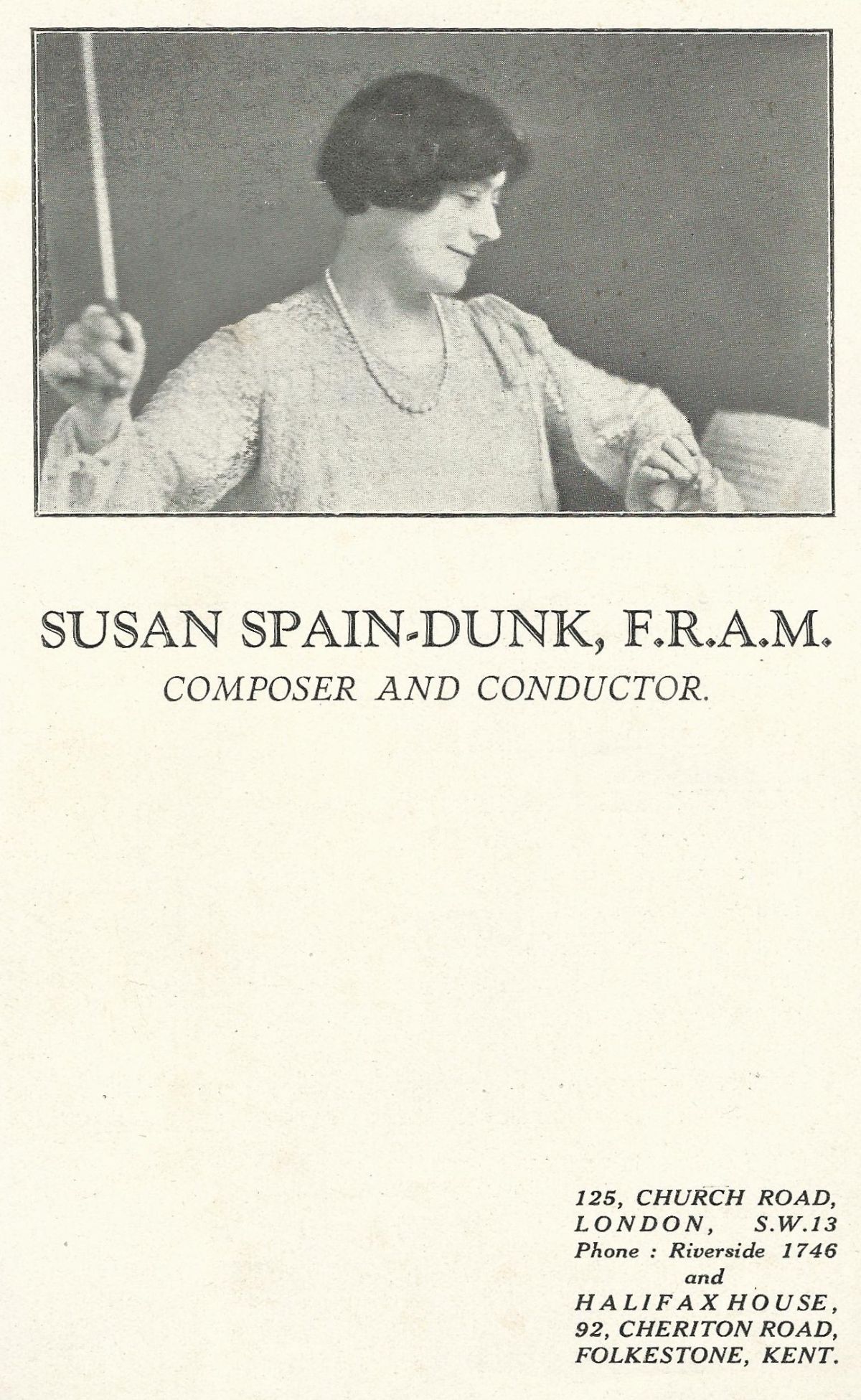
Susan composed her tone poem Elaine in 1927 and conducted it at the Proms on 25 August. This was during the first Proms season to be broadcast by the BBC from the Queen’s Hall and Susan was the first woman to conduct at a live broadcast from the Proms. The Daily Express wrote:
TENNYSON AT THE PROMS
COMPOSER WHO AVOIDS THE OBVIOUS
Last night’s Promenade Concert brought the second novelty of the season to the ears of the faithful. Each of the two new pieces which have been played has had as its subject a heroine from English literature whose death was more or less watery.
Mr. Frank Bridge last week gave us Shakespeare’s Ophelia in music, and now comes Miss Susan Spain-Dunk with Tennyson’s Elaine. Miss Spain-Dunk has found her inspiration from the ending of Tennyson’s story, which tells how the body of Elaine, who died for love of Sir Lancelot, was borne on a barge down the river to King Arthur’s palace. The composer has wooed our ears pleasantly. She has written some delightful passages for strings, and she has shown some skill in the blending of her themes. Her music is tenderly gay where many would have made it unbearably sombre, but its relation to its subject is not obvious at a first hearing.
This is the fourth successive season in which Miss Spain-Dunk has contributed to the Proms. Last night she conducted her own piece, which was warmly received.
— Daily Express, 26 August 1927
The Observer wrote: ‘A fine command of orchestration … skilfully balances orchestral tones’. The Southwark, Bermondsey and South London Gazette commented:
PROMENADE CONCERTS - Last week Miss Susan Spain-Dunk’s new work, “Elaine”, a poem for Orchestra was performed for the first time. We cannot but speak highly of Miss Spain-Dunk’s most recent composition, despite the fact that her earlier work, “The Kentish Downs” was possessed of a freshness lacking in “Elaine”. The orchestration is excellent, and the balances of instrumental tone exceedingly well worked out. We look forward with interest to her next work.
— Southwark, Bermondsey and South London Gazette, 2 September 1927
Sir Henry Wood mentioned The Kentish Downs and Elaine in the ‘List of important novelties’ in his autobiography.
Conducting at the Bournemouth, Eastbourne and Folkestone Festivals 1927–1932
Section titled “Conducting at the Bournemouth, Eastbourne and Folkestone Festivals 1927–1932”On 22 April 1927 Susan conducted The Kentish Downs and The Water Lily Pool at the concert of works by women composers organised by Sir Dan Godfrey as part of his Bournemouth Municipal Music Festival at The Winter Gardens. The Bournemouth Guardian commented that ‘the heroine of the evening was undoubtedly Miss Spain-Dunk, whose conducting of her two works was loudly applauded’.
In the 1927–28 Season at the Bournemouth Winter Gardens Susan conducted her Andred’s Weald overture which was later published in 1935 as The Farmer’s Boy, at a concert with Sir Dan Godfrey. In March 1928 she conducted Elaine in Bournemouth and on 28 February 1929 she conducted with Sir Dan Godfrey in the BBC broadcast of a concert by the Bournemouth Municipal Orchestra.
In November 1929 Susan conducted her The Kentish Downs at the Eastbourne Festival followed by a new work, Stonehenge. Some critics lambasted Stonehenge and the Eastbourne Chronicle wrote:
Stonehenge is very noisy, quite needlessly ugly, and notably deficient in thematic strength. I hope she will commit the score to the flames and develop the undoubted genius shown in The Kentish Downs.
— Eastbourne Chronicle, 30 November 1929
The Eastbourne Gazette took a more positive view of the music:
The composer tells us in an explanatory note that her poem is not intended to portray the savage sacrificial cries of the Druids, otherwise one might suspect from a certain quality of barbaric fury that it is really designed to symbolise those admirable old priests in one of their special celebrations. The writing of the poem shows good command of technical effects, and is virile and stimulating. There is a good deal of scholarly orchestration in both these works, and some clever fugal writing in the Overture.
— Eastbourne Gazette, 27 November 1929
Susan chose to quote both of these comments in her new promotional brochure, published in 1930.
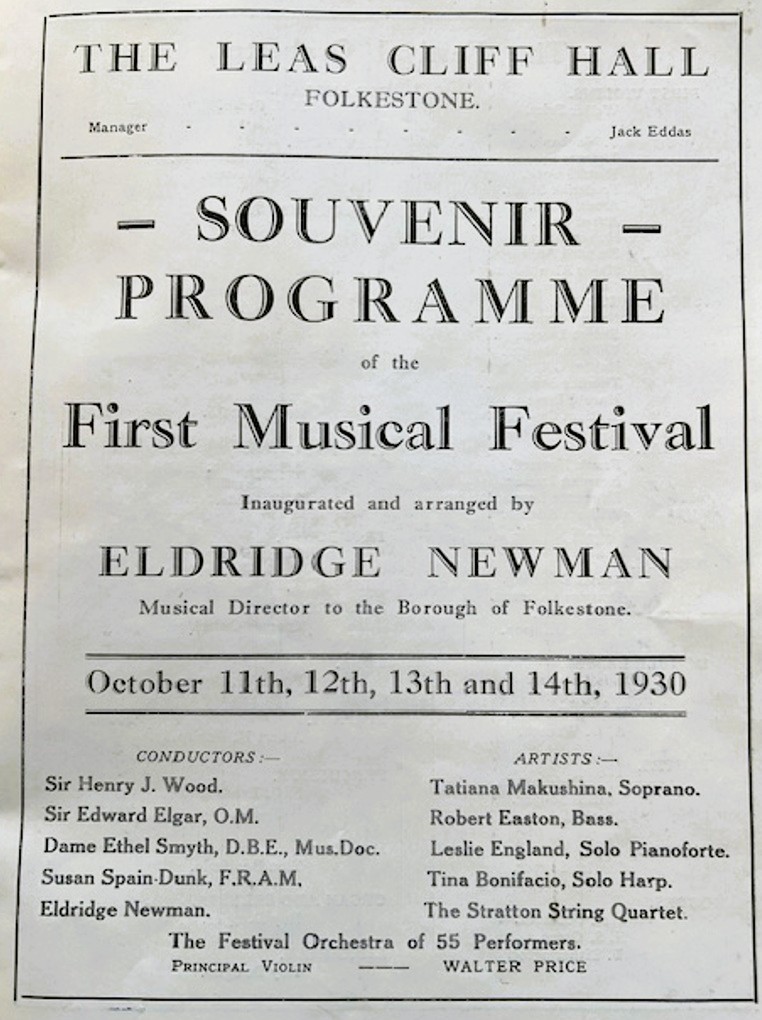
On 13 October 1930 Susan conducted The Kentish Downs and The Water Lily Pool at the first Folkestone Music Festival in the newly opened Leas Cliff Hall. Other conductors invited to the Festival included Sir Edward Elgar, Sir Henry Wood and Dame Ethel Smyth. The Daily Express wrote:
The overture was brilliantly played and conducted and the full beauty of the music revealed. The many picturesque and fantastic features of her other work The Water Lily Pool were exploited.
— Daily Express, 14 October 1930
The Folkestone Herald commented:
Miss Spain-Dunk was rapturously acclaimed at the close, recalled repeatedly, and presented with five handsome bouquets. Folkestone has every reason to be proud of its distinguished daughter, who has earned the right to be considered as one of the leading English composers of today.
— Folkestone Herald, 14 October 1930
In April 1931 Stonehenge was given its second performance when Susan conducted it in a concert with Sir Dan Godfrey in Bournemouth. This time it had a much better reception from the critics. The Bournemouth Times commented:
Miss Spain-Dunk, in addition to being a capable and effective conductor, or should we say “conductress”?! is a composer of thought and aim. In “Stonehenge” she has contributed a work of merit, absolute music constructed on a programme basis. MUSICAL PICTURE OF STONEHENGE The grim determination of its builders and the solid and immovable masses of stone themselves forming the famous temple of Neolithic times standing in lonely solitude on Salisbury plain are very vividly depicted in this Symphonic Poem.
— Bournemouth Times, 17 April 1931
Stonehenge was first broadcast by the BBC in 1932.
Viola playing and chamber music ensembles in the 1920s and 1930s
Section titled “Viola playing and chamber music ensembles in the 1920s and 1930s”Susan played the viola in Walter Willson Cobbett’s chamber music ensemble for many years. She became close friends with his wife Ada. They are both portrayed in Frank Owen Salisbury’s painting The Concert Party (1929). Susan is shown playing the viola and Ada sits in the foreground with her pet parrot.
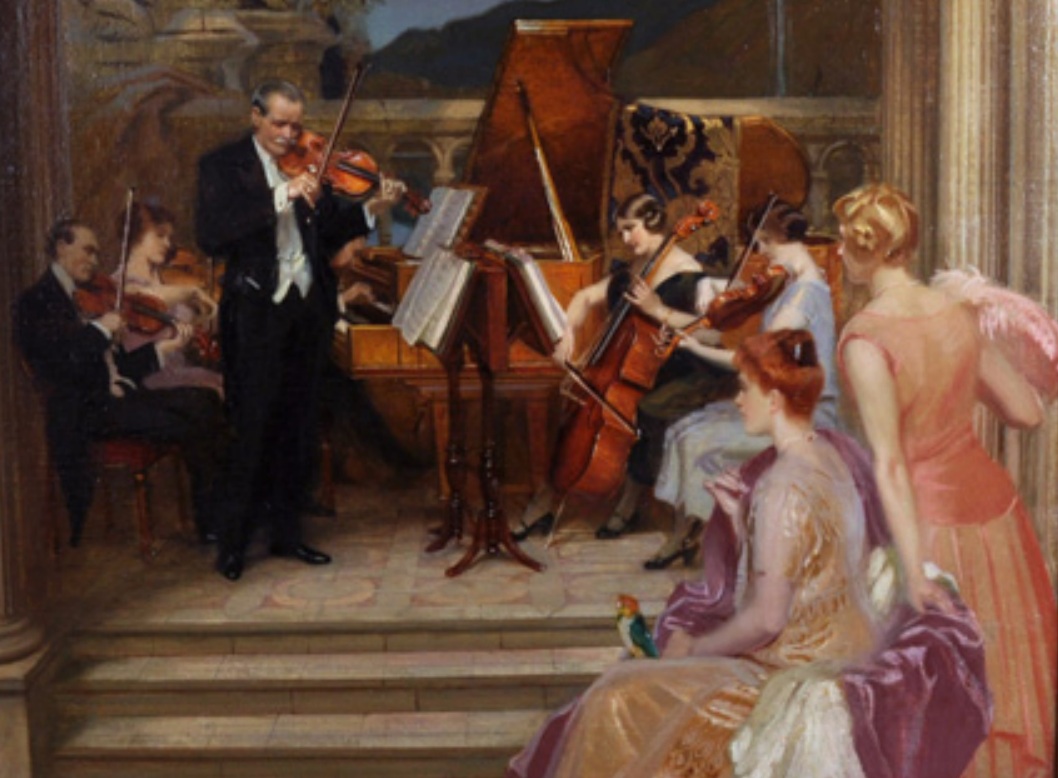
Susan plays the viola on the recording by W. W. Cobbett’s ensemble playing Schubert’s String Quintet, on the first record issued by the National Gramophone Society in 1924. The first 300 of these records were funded by Cobbett and issued free to members. One of Cobbett’s projects was the production of his Cyclopedic Survey of Chamber Music, first published in 1929. The research for this, which took a number of years, involved Cobbett’s ensemble playing through the many pieces that were reviewed. Susan persuaded Cobbett to engage her friend Maurice Drake Brockman, the music critic and composer, as his deputy editor. Several of Susan’s chamber music compositions are reviewed in the book.
For a time Susan played the viola in the orchestra of the Royal Opera House. She would sometimes take her small son Alan with her into the orchestra pit.
In the 1930s Susan formed her own chamber music ensembles, the Spain-Dunk Trio which broadcast a concert on 7 March 1932, and the Spain-Dunk Quartet which broadcast a concert on 19 November 1934. They also performed at various venues around the country.
Composing and conducting in the 1930s
Section titled “Composing and conducting in the 1930s”Susan composed one of her finest pieces, Cantilena, a tone poem for clarinet and orchestra, in 1930.
The first performance took place on 12 July, 1930, at a private concert in Folkestone which included the Phantasy Quartet by Imogen Holst. The soloist for this premier performance with piano was Reginald Kell. No mention is made of the pianist, though it can be safe to assume that it was the composer. A review from 26 July remarks that “Susan Spain-Dunk’s work was far ahead of all the others, both musically and technically…”.
It was not until later in December of 1931 that Cantilena (later called Poem) was to be heard as Susan had intended. The concert took place on the 5th of that month at the Queen’s Hall in London and was conducted by John Barbirolli. The concert was organised by Trinity College of Music - then situated on Marylebone High Street - and performed by its students, and the soloist was no exception; the clarinettist in question was a Herbert New, studying with Charles Draper. According to N. Porteous of the Folkestone Herald, “Miss Spain-Dunk’s concerto for clarinet and orchestra was warmly received by a large audience…”.
— Album notes by Peter Cigleris, from Rediscovered - British Clarinet Concertos, Cala Signum 2021
Cantilena was broadcast by the BBC in 1932.
In 1931 Susan wrote Notre Dame D’Albert and it was premiered by the Feltham Orchestral Society. The Middlesex Chronicle wrote: ‘A picturesque work full of interest and has moments of real beauty. The work received an ovation and the distinguished composer had to come forward and bow her acknowledgement’. It was also performed at the City Temple in London in 1932.
In 1932 Susan conducted the Royal Artillery Band at Woolwich performing her Andred’s Weald. A journalist claimed that this was the first time that a woman had conducted a British Army band. This was not the case, because Alicia Adélaide Needham had conducted the Irish Guards band at the Albert Hall twice during the First World War; articles soon appeared in the Northern Irish press pointing this out. The Folkestone Herald correctly stated that Susan was the first woman to conduct the Royal Artillery Band.
Susan composed Lorelei (Legend) for violin and piano in 1933, following an inspirational holiday to the Rhineland, and it was published immediately.
In 1934 she wrote Winter Song for Cello or Viola and Piano which was premiered by the cellist Brenda Sichel, to whom she dedicated the piece, at The Hampstead Concert Studio on 20 December. The Hampstead and St. John’s Wood Advertiser commented: ‘The warmth of her tone was particularly satisfying in Winter Song (first performance) by Susan Spain-Dunk – an interesting piece one could wish to be more acquainted with’. It was published in 1935. Susan also composed her Lament for String Orchestra at that time.
In 1934, following a visit to the tomb of Napoleon Bonaparte in Paris, Susan composed her overture Napoleon, which as far as is known was never performed or published.
In 1935 Susan and her son Alan went on holiday to Scotland where they met George Melbourne Loynd, the organist at the Argyll Square Church in Oban. Mr Loynd arranged a musical evening with friends at his house, where Susan played the violin accompanied by him on the piano. He played her some Scottish airs which inspired her to write her Highland Overture and Two Scottish Pieces – By St Mary’s Loch, and Kerrera which were both published in 1937.
In 1936 Susan, at the request of her publisher, wrote Six Spanish Dances for piano and two light pieces. The cover of Six Spanish Dances shows a rather scantily clad dancer. A journalist asked Susan what she thought of the cover and she replied, probably in jest, that she was ‘shocked!’ This comment resulted in a newspaper article which must have increased awareness of the publication.
In 1937 Susan became a Professor at RAM teaching harmony and composition.
Military and brass band compositions
Section titled “Military and brass band compositions”In 1925 Susan studied orchestration for military band at RAM under Dr (Major) Charles Hoby. In the same year she composed Kentonia, a concert march which was published and performed. She went on to write various works for military and brass bands.
Hindu mysticism and the Second World War years 1939–1945
Section titled “Hindu mysticism and the Second World War years 1939–1945”In the late 1930s Susan became interested in Indian mysticism and attended lectures by Dr Hari Shastri who taught Yoga philosophy and expounded some of the legends of Shri Krishna as spiritual allegories. In 1939 Susan composed The Flute Player of Brindavan, a tone poem for orchestra, and dedicated it to Dr Shastri. It was first broadcast by the BBC World Service in 1954. In 1940 she composed Somya Devi or Blessed Somya, a prelude for orchestra, and had it recorded at her own expense. Some extracts from the recording survive. Her son Alan, an Anglican clergyman, later considered these to be two of her finest works and discussed them in detail when he gave lectures about his mother.
In 1940 Susan also wrote The Castle overture. As far as is known it has never been performed or published.
Susan remained in London during the worst of the Blitz in 1940. In 1941 her son Alan, who was a curate and air raid warden in Battersea at the time, persuaded her to leave London. She resigned her professorship at RAM and took lodgings in Beaconsfield outside London with a retired clergyman, Rev. Henry J. Trueman, an amateur musician and hymn writer, who had two pianos in his house. Whilst there she composed two piano preludes, a Prelude for organ and Two Pieces for Two Pianos based on Two Hymn Tunes by the Rev. H. J. Trueman.
In 1941 the Queen’s Hall in London was destroyed by bombing and the scores and parts of orchestral works by Susan and other composers were destroyed.
Susan’s son Alan joined the Army in 1942 and was posted overseas. She returned to London to be near her friends. When the war ended in 1945, Susan wrote Joyous Fanfare, an overture for orchestra which remains unperformed and unpublished.
Post-war years 1945–1962
Section titled “Post-war years 1945–1962”In the post-war period Susan remained in London and spent much of her time revising the scores of her most successful works and negotiating to have them played. In 1955 she started to compose again and wrote Legende for Oboe and Orchestra.
In 1955 her son, now an Army Chaplain, moved to Malaya and wrote to her frequently describing his trips into the jungle with the Army. This inspired her to compose her last orchestral work, a tone poem called Malaya. This was never performed in her lifetime, but was recorded by the BBC Scottish Symphony Orchestra in 2021 and premiered on BBC Radio 3.
Susan’s final publication in 1960 was Two Pieces for Violin and Viola – The Lonely Moor and Jig. The manuscript for this is undated but it appears to have been composed much earlier, possibly in the late 1930s.
Susan’s last two works were inspired by the Bible. In 1958 she composed a short anthem for voices with string and harp accompaniment, taking some verses from Psalm 43 ‘O send out thy light and thy truth that they may lead me’. This was the last of her works to be broadcast in her lifetime. It was included by her friend Rae Jenkins, conductor of the BBC Welsh Orchestra, in some of his Sunday programmes.
In 1959 she began to compose a cantata, The Baptism of Jesus, with words taken from the Bible and arranged by her son Alan. He asked her to make it easy enough for an average church choir to sing. It was not performed during her lifetime but was recorded by The BBC Singers in 2018 and has been broadcast.
Susan died from a stroke in her flat in London on New Year’s Day in 1962. She was 81 years old. Her works, like those of many other women composers of her time, were forgotten in the years that followed.
Rediscovery and revival
Section titled “Rediscovery and revival”From the time of Susan’s death until 2018 there were very few performances or broadcasts of her works, apart from concerts by the Folkestone Symphony Orchestra who kept interest alive in her home town. Although manuscripts of nearly all of her works and some publications were preserved by her family, most of the scores and parts had either been destroyed with the Queen’s Hall in 1941 or “lost” by her publishers who could no longer provide them when asked.
In 2018, the clarinettist Peter Cigleris wished to perform and record Cantilena. He contacted Susan’s grandchildren, transcribed and edited Cantilena from the manuscript and arranged meetings with the BBC. He then transcribed Susan’s orchestral works so that they could be recorded and performed. The first modern recording of one of her works was Lament for String Orchestra, a work apparently never performed in her lifetime, by the BBC Symphony Orchestra conducted by Michael Collins, broadcast in 2018. A live broadcast of Stonehenge by the BBC Concert Orchestra conducted by Anna-Maria Helsing soon followed in 2019.
Early in 2019, Peter Hatfield transcribed Susan’s Rhapsody Quintet for Wind from the manuscript and performed it with his colleagues from the Trondheim Symphony Orchestra at a series of concerts.
There are now more recordings of Susan’s music available than in her lifetime. Over 120 manuscripts of her works survive and only five are currently lost.
Although some of Susan’s best works have been recently recorded, there are many more that could be performed and recorded by those who are interested.
Sources
Section titled “Sources”1 – Autobiographical notes on music in Folkestone as a child and teenager by Susan Spain-Dunk, c.1954. Gibson family archives.
2 – Susan Spain-Dunk, Kentish Musician 1880–1962. Lecture notes by her son Rev. Alan Gibson 1974, pp. 1-20. Gibson family archives.
3 – Some Folkestone Worthies – Ten outstanding persons who have contributed to the life and development of old Folkestone. C. H. Bishop c.1976, pp. 24-27
4 – Sir Dan Godfrey, Champion of British Composers. Stephen Lloyd 1994, Thames Publishing, London, pp. 31, 137, 172-3, 183, 184, 187, 199.
5 – Music for the Love of It. Episodes in Amateur Music Making. Joel Epstein 2022 ISBN 978-965-92782-3-7, pp. 120-141.
6 – British Library Music Catalogue: S. Spain-Dunk
7 – Survey of women composers and conductors listed in Proms programmes 1923–1944. David Gibson 2025 (unpublished).
8 – British Music for Strings III – South West German Chamber Orchestra CD, Programme Notes. Lewis Foreman 2021, page 17.
9 – Susan Spain-Dunk signed manuscripts, publications, concert programmes and press cuttings. Gibson family archives.
10 – Diary of Catherine Dunk (Susan Spain-Dunk’s mother) 1874–1914. Gibson family archives.
11 - Yours Affectionately. Letters written to his uncle and mother, during the Blitz, by Rev. A. H. Gibson, between September 11th 1940 – May 13th 1941. Published by Jean Little, Susan’s granddaughter.
12– My Life in Music - the autobiography of Sir Henry Wood. Henry Wood, 1938, Victor Gollancz Ltd.
13 – Royal Academy of Music Library, London
14 – British Newspaper Archive
15 – Susan Spain-Dunk’s Autograph Book. Gibson family archives.